THE NEW ENTERPRISE LAYER
Agents are becoming
part of the workforce.
They access data, invoke APIs, operate software and make decisions. Enterprises need infrastructure that treats autonomous systems as managed organizational actors rather than disconnected AI experiments.
CONTROL PLANE
IDENTITY
↓
POLICY
↓
EXECUTION
↓
EVIDENCE
ENTERPRISE CONTROL SURFACES
One operating layer for every autonomous system.
01 / KNOW
Inventory
Discover every agent, owner, model, tool, environment and deployment.
02 / GOVERN
Policy
Define permissions, limits, approvals, obligations and operating boundaries.
03 / SEE
Observe
Trace actions, tools, decisions, costs, failures and business outcomes.
04 / PROVE
Audit
Produce attributable evidence of who did what, under which authority.
AGENT DIRECTORY
Know every agent
inside the enterprise.
Maintain a canonical inventory of autonomous systems across teams, clouds, frameworks and vendors—along with their owners, purpose, privileges, deployment status and risk classification.
ENTERPRISE / AGENT DIRECTORY
finance-close
FINANCE / CONTROLLER
PRODUCTION APPROVED
vendor-agent
PROCUREMENT / OPS
PRODUCTION APPROVED
research-pilot
STRATEGY / LABS
SANDBOX REVIEW
AGENT IDENTITY
Every autonomous actor
gets an identity.
Bind every agent to a verifiable organizational identity with an accountable owner, defined purpose, lifecycle status and scoped authority.
AUTHORIZATION
Identity says who.
Runtime decides whether.
Evaluate permissions in context at the moment an agent attempts to read data, invoke a tool, call another agent or change an enterprise system.
HUMAN ACCOUNTABILITY
Every agent has
a responsible owner.
Associate autonomous systems with accountable people, teams and business functions so ownership survives organizational change and access can be reviewed throughout the agent lifecycle.
POLICY-AS-CODE
Write the rules once.
Enforce them everywhere.
Translate enterprise requirements into machine-enforceable runtime policies applied consistently across agents regardless of model, framework or development team.
ENTERPRISE / POLICY
agent = procurement
action = create_purchase_order
amount = 18400
threshold = 10000
decision = REQUIRE_APPROVAL
APPROVAL GATES
Autonomous where safe.
Human where required.
Let routine work proceed automatically while sensitive, irreversible or high-value actions pause for the appropriate human or supervisory approval.
OBSERVABILITY
See what your
agents actually do.
Capture runtime telemetry across agent decisions, model calls, tool invocations, external actions, errors, latency and cost so operators have an execution-level view of autonomy.
ENTERPRISE / LIVE ACTIVITY
AUDIT TRAIL
Every action leaves
enterprise evidence.
Connect runtime actions to the agent, human principal, policy, tool, data source and resulting effect so security, risk and audit teams can reconstruct what happened.
DATA BOUNDARIES
Enterprise data stays
inside enterprise rules.
Apply contextual controls to the information agents can retrieve, transform and expose—preserving existing organizational permissions instead of turning agents into access shortcuts.
TOOL GOVERNANCE
Control what agents
can actually touch.
Maintain an approved catalog of APIs, applications, databases and machine tools with explicit capabilities, permissions and usage policies for autonomous systems.
ENTERPRISE / TOOL CATALOG
CRM / CUSTOMER RECORDS
READ + LIMITED WRITE
APPROVED
ERP / PURCHASE ORDERS
CREATE + APPROVAL
APPROVED
PAYMENTS / TRANSFER
RESTRICTED
CONTROLLED
MODEL NEUTRAL
Govern the agent.
Not just the model.
Enterprise control should survive model changes. Standardize identity, policy, observability and audit around the runtime while teams remain free to choose appropriate intelligence providers.
FRAMEWORK NEUTRAL
One control plane.
Many agent stacks.
Apply common enterprise controls across internally developed agents, third-party platforms, departmental automations and future agent frameworks without rebuilding governance for each stack.
LIFECYCLE MANAGEMENT
From experiment
to retirement.
Track agents through development, evaluation, approval, production, modification, suspension and retirement with ownership and controls attached throughout the lifecycle.
KILL SWITCH
Stop one agent.
Or an entire class.
Suspend execution, revoke authority or disable a category of autonomous systems when policy, security or operational conditions require immediate intervention.
COST GOVERNANCE
Know what autonomy
costs the enterprise.
Allocate model, compute, API and external service costs to agents, teams, business units and workflows while enforcing budgets and consumption policies.
ORGANIZATIONAL POLICY
Controls follow
the organization.
Apply policies hierarchically across the enterprise, business unit, department, agent class and individual runtime so local teams can move quickly inside centrally defined boundaries.
POLICY / INHERITANCE
GLOBAL ENTERPRISE
↓
↓
AGENT-SPECIFIC POLICY + LOCAL EXCEPTIONS
ENVIRONMENT SEPARATION
Experiment freely.
Promote deliberately.
Separate sandbox, development, staging and production agent environments with increasingly strict controls and explicit promotion gates between them.
CHANGE CONTROL
Know when an agent
has changed.
Track changes to models, prompts, tools, policies, data access and runtime configuration—and require reevaluation when a material change alters the agent's operating profile.
COMPLIANCE EVIDENCE
Turn runtime activity
into audit evidence.
Continuously collect execution records, policy decisions, approvals, access events and ownership metadata so compliance is supported by operating evidence rather than documentation alone.
INCIDENT CONTROL
When autonomy misbehaves,
respond like operations.
Detect anomalous behavior, freeze permissions, isolate affected runtimes, preserve evidence and route incidents into established enterprise security and operations processes.
BUSINESS OUTCOMES
Connect agent activity
to enterprise value.
Move beyond token counts. Measure autonomous systems against business outcomes such as resolution time, revenue influenced, work completed, cost avoided and human hours returned.
AGENT SERVICE LEVELS
Operate agents like
production systems.
Define reliability, latency, quality and error objectives for autonomous workloads, then monitor performance and intervene when systems move outside their operating envelope.
EXECUTIVE VIEW
One view of enterprise
autonomy.
Give technology, security, risk and business leadership a common picture of where autonomous systems operate, what authority they possess and how they are performing.
EXECUTIVE / CONTROL BOARD
AUTONOMY COVERAGE
42%
eligible workflows
POLICY COVERAGE
99.7%
production agents
VALUE / MONTH
$4.8M
measured impact
OPEN RISKS
12
requiring review
ENTERPRISE INTEGRATION
Autonomy plugs into
the systems you already run.
Connect agent operations to enterprise identity, security, IT service management, SIEM, data governance, cloud infrastructure and financial management rather than creating a parallel AI control universe.
ENTERPRISE / INTEGRATION FABRIC
FEDERATED CONTROL
Central standards.
Local innovation.
Platform teams define enterprise-wide guardrails while individual business units build and operate agents inside approved boundaries appropriate to their workflows.
AUTONOMY AT SCALE
From ten agents
to ten thousand.
The governance problem changes when autonomous systems proliferate. RuntimeEnterprise provides shared control primitives so organizational oversight scales without requiring every team to reinvent security and operations.
NONHUMAN WORKFORCE
People. Applications.
Agents.
The enterprise operating model is expanding beyond human users and traditional software. Autonomous actors introduce a third class of participant that requires identity, authority, accountability and lifecycle management.
TRUST BOUNDARY
Trust the system.
Verify the action.
Enterprise autonomy should not depend on assuming that an agent will always behave correctly. Runtime controls evaluate identity, context, policy and authority as actions occur.
AUTONOMY GOVERNANCE
Govern capability,
not conversation.
The critical enterprise question is increasingly not merely what an AI system says, but what it can access, which actions it can execute and what consequences those actions can create.
ENTERPRISE RUNTIME
Put enterprise controls
in the execution path.
Move governance from static documentation into runtime infrastructure where identity, authorization, approvals, policy and telemetry can participate directly in autonomous execution.
ENTERPRISE AUTONOMY / STACK
LAYER 06
BUSINESS WORKFLOWS
LAYER 05
AGENTS + AUTONOMY
LAYER 04
RUNTIME ENTERPRISE
LAYER 03
IDENTITY · POLICY · OBSERVABILITY
LAYER 02
DATA · TOOLS · APPLICATIONS
LAYER 01
ENTERPRISE INFRASTRUCTURE
THE CATEGORY
The control plane for
the autonomous enterprise.
A unified operating layer connecting agent identity, runtime policy, permissions, observability, lifecycle, cost, security and compliance across the organization.
CORE POSITIONING
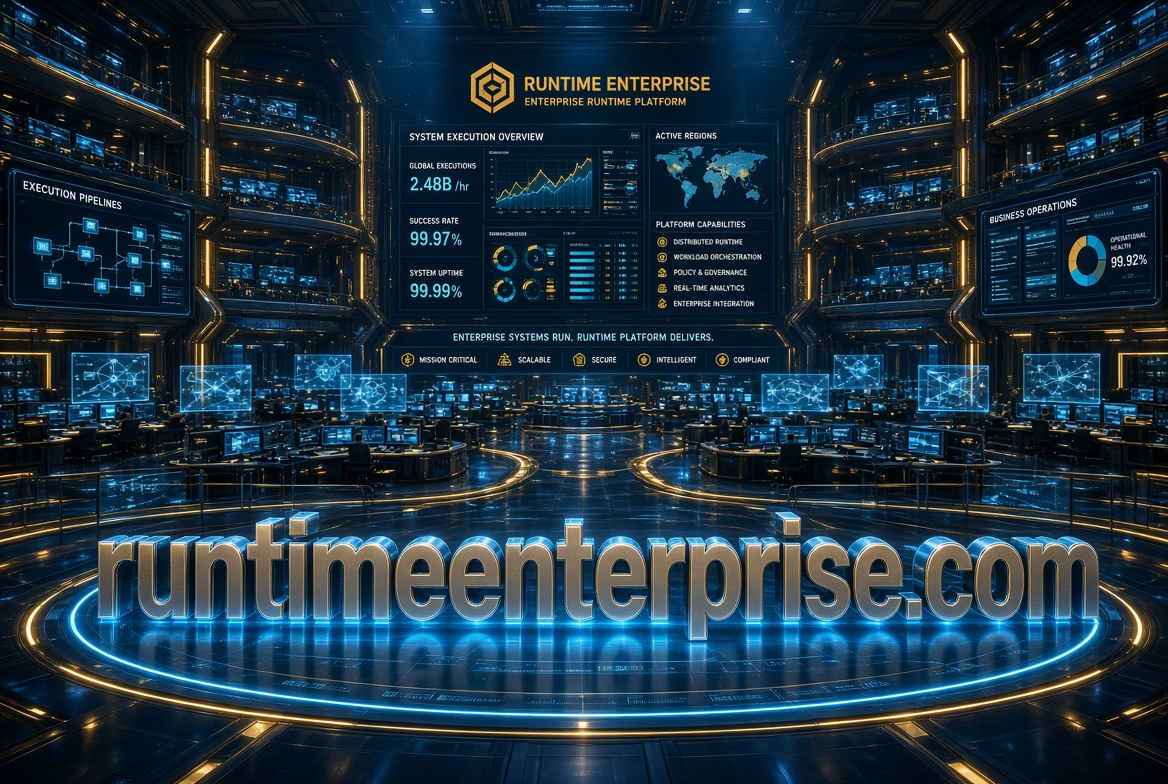
RuntimeEnterprise.com
The enterprise control plane for autonomous systems—giving organizations the infrastructure to govern, operate and scale AI agents across the business.
RUNTIMEENTERPRISE.COM
Autonomy. Under control.
IDENTITY → POLICY → EXECUTION → EVIDENCE